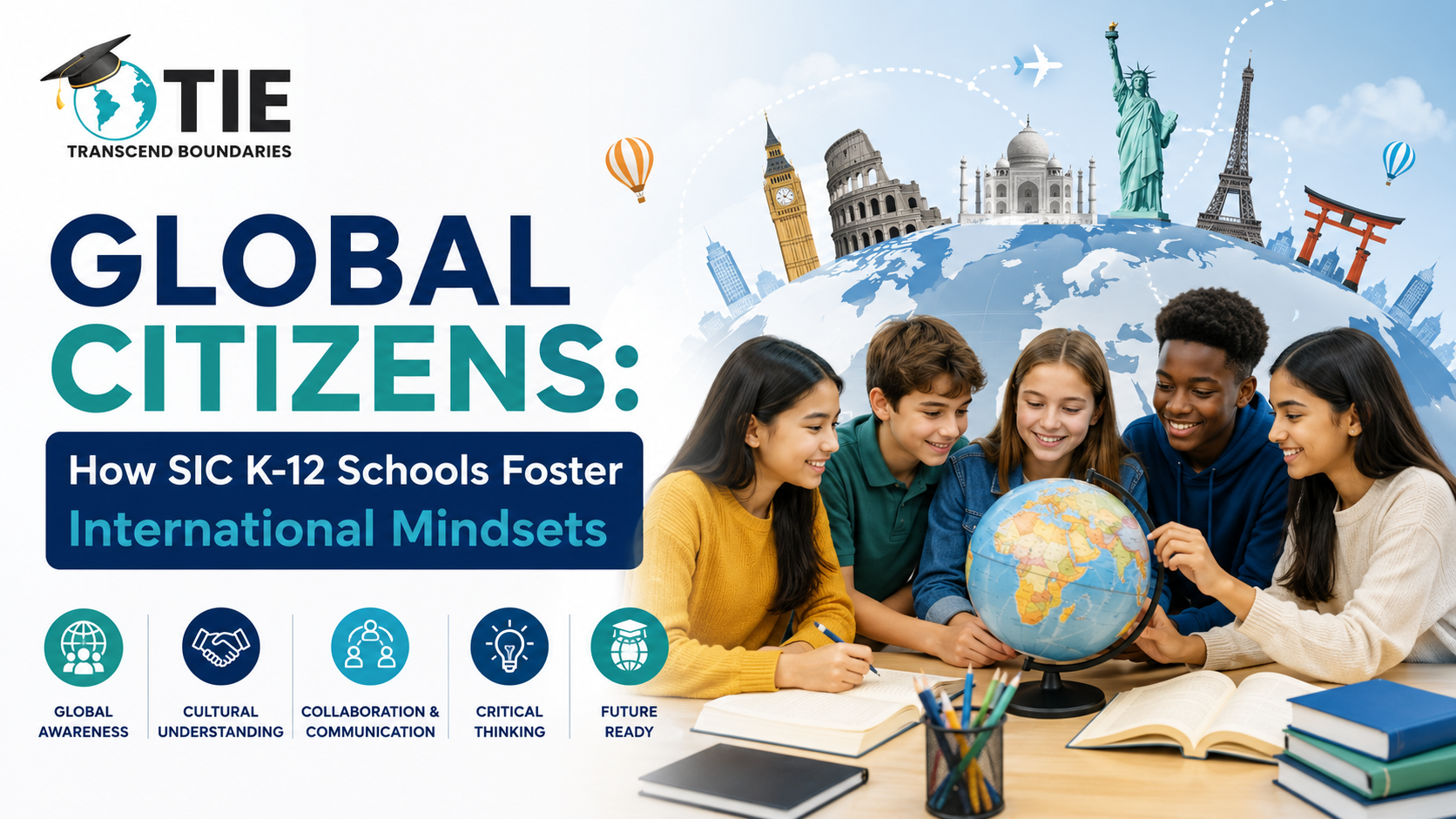
Global Citizens: How SIC K-12 Schools Foster International Mindsets
Taksheela Team
Taksheela Institute of Education
Introduction: India’s Moment of Opportunity
Raising globally competent citizens is no longer an option, it's pretty much a necessity, considering the rapid increase in the interconnectivity of the world we live in right now.
From climate change to AI ethics, the challenges of tomorrow will require empathy, collaboration, and a deep understanding of cultures beyond borders. Global citizenship education is now emerging as a crucial aspect of future-ready learning.
India is rising to this call with bold intent. The nation is laying the groundwork for a generation of students equipped to thrive globally through landmark initiatives like the National Education Policy (NEP) 2020, digital learning frameworks, and a strong push toward multilingual and multicultural education. Turning this vision into the reality of daily classroom practice requires global education models customised for India's environment.
Enter SIC K–12 Schools — pioneers in embedding global citizenship into the heart of early education. These schools aren’t simply following international trends; they’re setting new standards for global readiness in Indian classrooms.
Taksheela Institute of Education recognises the importance of global education and the role it plays in helping students develop the knowledge, skills, and perspectives needed to thrive in an increasingly interconnected world.
NEP 2020: A Vision for Global Competence
National Education Policy (NEP) 2020 is India’s framework for transforming education at all levels. The National Education Policy (NEP) 2020 acts as the baseline for a modern, globally aware education system.
It emphasises:
Multilingualism and ability to navigate both local and international environments
Critical thinking and problem-solving
Ethical values and intercultural understanding
Digital learning and global connectivity
NEP 2020 envisions young Indians as confident global citizens with Indian values and international perspectives.
The RTE Act
The Right to Education (RTE) Act provides the legal framework for universal access to education. It provides access while also permitting curricular creativity in implementing global education
Policy Gaps and the Call for Innovation
Insights from the Centre for Civil Society (CCS) point out:
India has too many regulations but limited space for innovation
Autonomy in curriculum design is often missing
There’s a growing need for schools that blend policy compliance with forward-looking pedagogy.
Key Indian Education Policies Supporting Global Citizenship Education
SIC K–12: Bridging Policy and Practice
SIC K–12 Schools are fully compliant with Indian laws while being globally progressive:
They align with NEP’s focus on multilingual, values-based, and skill-rich learning
They provide a globally benchmarked curriculum within Indian regulatory frameworks
They model what policy in action looks like for global citizenship education
Leading the Way: Schools Implementing Global Citizenship Education in India
India is home to many schools that embrace global citizenship education, blending international curricula with Indian values and policy alignment. These schools offer global exposure and cultivate young minds that don't limit their thinking to familiar borders.
SIC K–12 Schools: A Flagship Model
They offer an internationalised, inquiry-based curriculum that works with the NEP 2020 values:
Focus on multilingualism, ethical reasoning, and real-world problem-solving
Promotes student exchange programs, global issue projects, and service learning
Fully aligned with Indian education regulations
Indian Schools Promoting Global Citizenship
The International School Bangalore (TISB)
IB and IGCSE curriculum
Emphasis on global contexts, Model UN, and student leadership
Pathways World School, Aravali
IB curriculum across all grades
Interdisciplinary learning with a focus on sustainability and social impact
Dhirubhai Ambani International School, Mumbai
Strong international faculty and programs
Global exposure through both academic and cultural initiatives
Key Indian Schools Promoting Global Citizenship Education
These schools reflect India's potential to lead in international education innovation, preparing globally minded students from a young age.
Why Global Citizenship Begins in K–12 Education
The values, skills, and mindset required to thrive in a connected world must be nurtured from childhood. According to UNESCO and OECD, Global citizenship education or GCED equips learners to take meaningful action at local and global levels to foster societies that are peaceful, inclusive, and sustainable
Why Early Exposure Matters
Children between the ages of 5–16 are:
Highly adaptable and impressionable
Rapidly developing their identity, empathy, and social awareness
Most open to understanding differences and building inclusive perspectives
Long-Term Benefits of Starting Early
Empathy and emotional intelligence: Understanding others across cultures
Cultural literacy: Recognising diverse histories, languages, and values
Ethical decision-making: Applying values like justice and sustainability
Confidence in global interactions: From communication to collaboration
By embedding global perspectives into early education, schools create future-ready professionals and conscious global citizens. SIC K–12 schools ensure these foundational qualities are not an option, and work towards making them an important part of the students' early learning.
SIC’s Vision: A Truly International Curriculum
SIC K–12 schools believe that international education should not be reserved for the privileged few or confined to high school years. Instead, global learning begins from day one - right from the earliest classes in school
SIC adopts a hybrid international curriculum model that includes the best of IB (International Baccalaureate) , Cambridge International and India’s NEP 2020-aligned frameworks.
Subjects Through a Global Lens
At SIC, students explore:
History through multiple cultural narratives
Geography with a focus on environmental stewardship
Science as a shared human endeavour
Literature from around the world to build empathy and perspective
Inquiry-Based, Project-Driven Learning
Global issues aren’t abstract. Students work on real-world challenges like:
Climate change
Food security
Peacebuilding and equity
They develop solutions, present findings, and collaborate with people from diverse cultures, which helps them gain real-world experience.
Multilingualism as a Bridge
Language learning is more than just studying; it involves both social and cultural experiences. SIC K–12 schools teach students in multiple languages and encourage language exchanges with their partner schools. This helps students not only improve their English but also keep in touch with their native languages, helping them stay connected to their culture.
Building Lifelong Skills
The curriculum offered by SIC K-12 develops skills that students will need not only right now, but later in life. Critical thinking, ability to adapt in unfamiliar environments, and collaboration are emphasised the most as these are skills that help students not get flustered by a world that is getting more and more complicated everyday.
Co-Curricular Activities That Matter
Students engage in activities that work alongside classroom learning, such as:
Model United Nations (MUN)
Service learning projects focused on both local and global issues
Projects that encourage cultural exchange within communities
These experiences help develop empathy, leadership qualities, and real-world problem-solving.
Multilingualism
Multilingualism is strongly encouraged at SIC. For example, you need to be fluent in Norwegian to land a permanent position at any job in Norway. SIC K-12 understands that and therefore emphasises learning multiple languages to prepare students for local and global real-world opportunities.
Digital Literacy
Digital literacy is also a priority. Students learn to use technology responsibly and creatively, preparing them for the digital economy. This is especially crucial as the current world is completely digitalised in all sectors of life, and thus being tech-savvy gives you a competitive edge.
Student Agency and Global Leadership
SIC empowers students to take charge of their learning and contribute meaningfully to the world. These leadership programs encourage students to lead global initiatives, advocate for causes they care about, and collaborate with people across the globe
The goal is to nurture confident, compassionate global citizens ready to lead in any context.
The US Model of Global Citizenship Education
Global citizenship education at the K–12 level in the United States is generally not run by a single national body. Schools and districts decide, on their own, how to include global themes leading to differences in implementation across the states.
Although international studies and cultural activities are common in U.S. schools, there’s no single national curriculum for global citizenship.
India’s Emerging Unified Vision
India on the other hand is moving toward a more integrated and consistent approach using NEP 2020. SIC K–12 schools combine international curriculum standards with national goals which then helps create a clear roadmap for global citizenship education, making sure that all students are exposed to global issues and skills from the earliest stages of education.
Global Citizenship Education: India (SIC K–12) vs. United States – A Comparative Overview
India’s Global Education Future Starts Now
India is at an exciting point in its education system. The National Education Policy 2020 outlines a clear plan for the future of education. It highlights the importance of learning different languages, gaining skills that are relevant in today's world, and developing a global perspective. Schools under the SIC K–12 system are putting these ideas into action.They combine international teaching standards with how India's educational system is accustomed to, creating a structure that helps students prepare for success globally. Instead of just learning about world issues from books, students get to engage in real-life experiences through exchanges, collaborative projects, and teamwork, giving them a better idea of what working in the real-world looks like.
Education focused on global citizenship gives students the skills required to make a positive difference in the world. Supporting models like SIC will make sure that global citizenship education becomes accessible to all Indian children, regardless of where they are from or what their background looks like.
Lets embrace global education to raise the next generation of leaders who think beyond borders and act with compassion and purpose.
Free MBBS Counselling
Find the Right Country for Your MBBS in 2026
Our MBBS specialists analyse your NEET score, budget and career goals to recommend the right university — at zero cost to you.
Related Articles
Planning your study abroad journey?
Get free expert counselling from Taksheela — trusted by thousands of Indian students for admissions, visas, and test prep.
You May Also Like
More Study Abroad & Education Guides
The "China Exit": Why African Students Are Now Choosing India Over Beijing?
05 Jun 2025 · 12 min